

The Presenting Presidency vs. The Governing Presidency
Do we just want our presidents to rally and emote?

In this column:
* Head of State vs. Head of Government
* Graphing post-WWII Presidents
* Populism is Mostly Presentment
* Graphing Potential 2028 Candidates
Statecraft
I’ve been writing a long piece about Ben Sasse, Daniel Patrick Moynihan, and statecraft.
I’m interested in how public officials do or do not use their energy, smarts, and experience to get things accomplished through government. That is, some leaders use their positions to pass laws, launch initiatives, execute big programs, etc. That’s what they should be doing as public officials. That’s their job after all.
Other leaders, sadly, use their positions to talk a lot and try to become famous. This is related to my friend Yuval Levin’s point about the official who sees his institution as a platform to get attention and build a personal brand.
Although it’s un-republican1 and a waste when officials go the attention/brand-building route, the presidency can actually welcome some of this “presenting”—if it’s done smartly and with the public good in mind.
Head of State or Government?
Here’s what I mean. Recall our high school civics lesson that the presidency combines two roles: head of government and head of state. The first encompasses the official duties associated with leading the executive branch.
But the second (head of state) means the president has a ceremonial, symbolic, communicative role. S/he represents the nation on the international stage, of course. But this also includes signaling domestically—through speeches, appearances, persuasion, appointments, proposals—what our national challenges and aspirations are. It means showing vigor and patriotism, celebrating accomplishments, and demonstrating moral fiber.
In this way, the president needs to be the American public’s public figure not just a high-level government operator.
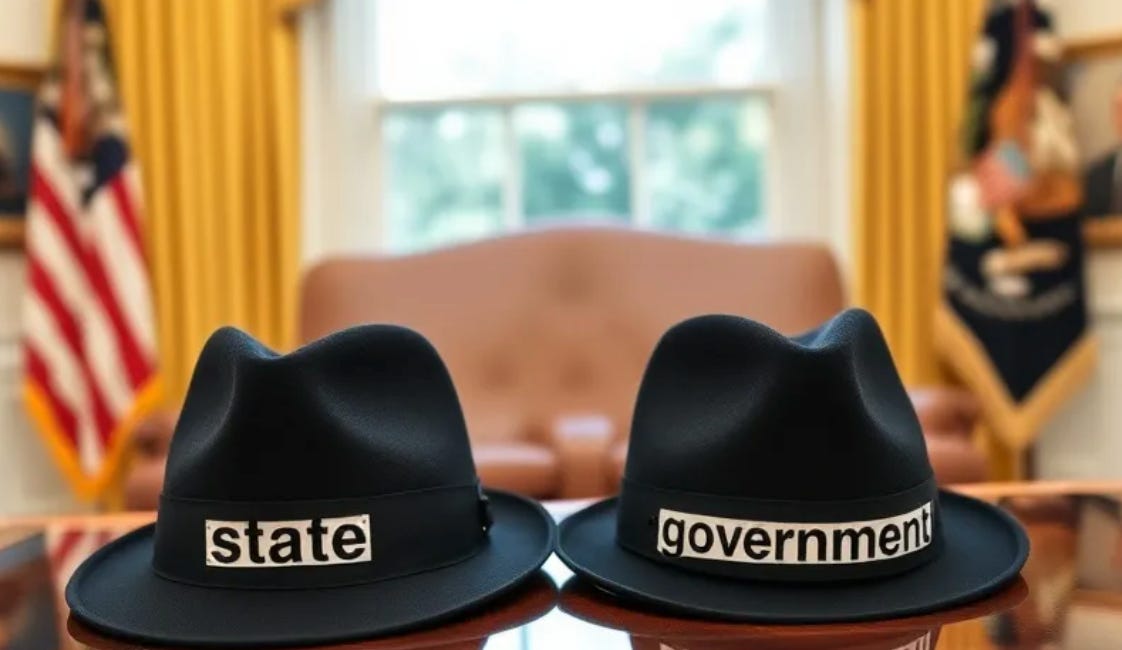
The C-SPAN historians’ survey of US presidents’ effectiveness helps show the difference between the two hats the president wears. Although it has an overall score (and ranking) for each president, it also has scores for categories of presidential activity. Some of these are more head-of-government-related (e.g., administrative skills, relations with Congress). Some are more persona- or presenting-related (e.g., moral authority, public persuasion).
A president could be good at governing and presenting; be good at neither; or be good at one but not the other. Indeed, this variety is exactly what I see when I look at presidents since FDR.
Graphing Post-WWII Presidents
Below I’ve created a graph showing the two dimensions: the X-axis for “governing” and the Y-axis for “presenting.”
I located each president based on his effectiveness on the two dimensions: How effective at governing, and how effective at presenting.2 To be clear: I might not like the governing agenda of the president, but he could be effective at governing; I might not like the image/message he’s presenting, but he might be effective at presenting it.
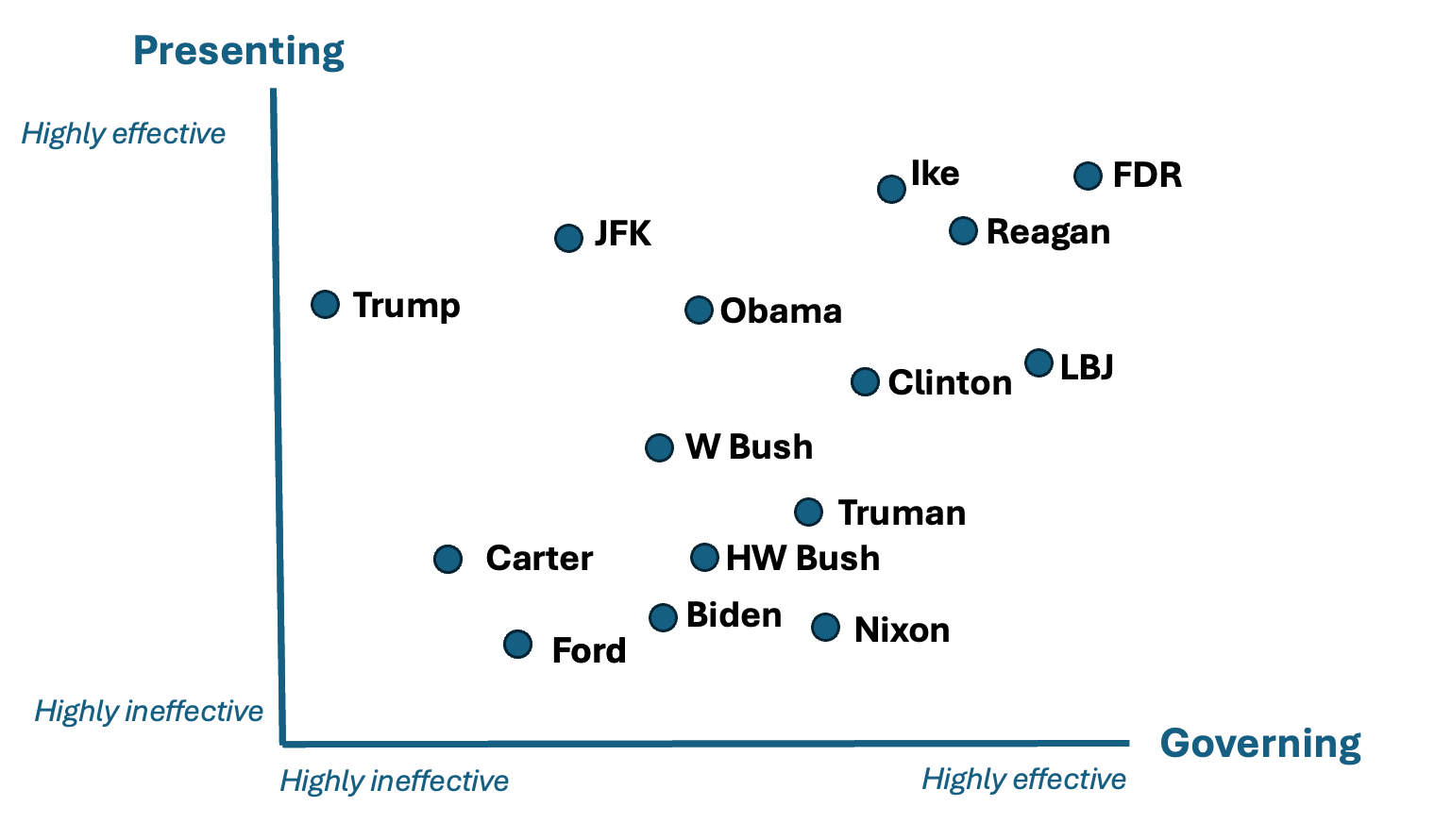
For instance, JFK wasn’t the most effective president at governing, but he was adept at projecting a post-FDR-Truman-Ike image of America: idealism, optimism, youth, energy, glamour, best-and-brightest-ism. Truman might’ve been a more effective inside-the-system governing leader, but he certainly lacked JFK’s aura and verve.
President Trump has been a remarkably ineffective governing leader. He has no legislative agenda of which to speak. DOGE failed badly. His executive orders are often set aside by the courts.
But he has relentlessly presented his national vision to the public: reanimating American greatness, dramatically decreasing immigration, fighting progressive culture, showing toughness on crime, elevating American interests on the international scene, etc. His social media presence and public events dominate the public conversation and continuously reiterate his message. Regardless of one’s views about his vision, it’s hard to dispute that he ably presents his feelings about and desires for the nation.
Populism and Symbolism
It is often said that populism and governing don’t mix. The most famous populist leaders across history either never attain major governing positions or accomplish little of lasting meaning if they do attain those positions.
One reason for this is that populism is typically more of a feeling and a posture than an actionable agenda. It is angry at the status quo and those who’ve been in charge, but it lacks specific, realistic remedies as well as the skills and dispositions to lead public institutions.
But, importantly, populism does scratch an itch. It gives voice to the frustrations of the people. It offers a picture—even if a blurry one—of how things ought to be.
The big question related to GOP primary voters in 2028 is the extent to which they want someone who is capable of governing well, i.e., using the powers of the office to accomplish governing goals, and the extent to which they want someone who is adept at using the bully pulpit to talk passionately about issues.
I used to think that primary voters cared first and foremost about candidates’ views on the key issues of the moment: i.e., what positions does the candidate take, and how would s/he use the official powers of the presidency to affect these issues? But I think today’s primary voters care a great deal about “presenting.”
But I also think that the GOP realizes that it’s been a long time since we’ve had a president effective at governing.
So it’s worth thinking about which potential candidates might excel at presenting and which might excel at governing. The image below reflects my current sense of the focus of the most prominent possible candidates. Again, this doesn’t take into account their views on particular issues, their relative MAGA-ness, their relative populism, their relative conservative-ness, etc. This just considers the two dimensions discussed here.
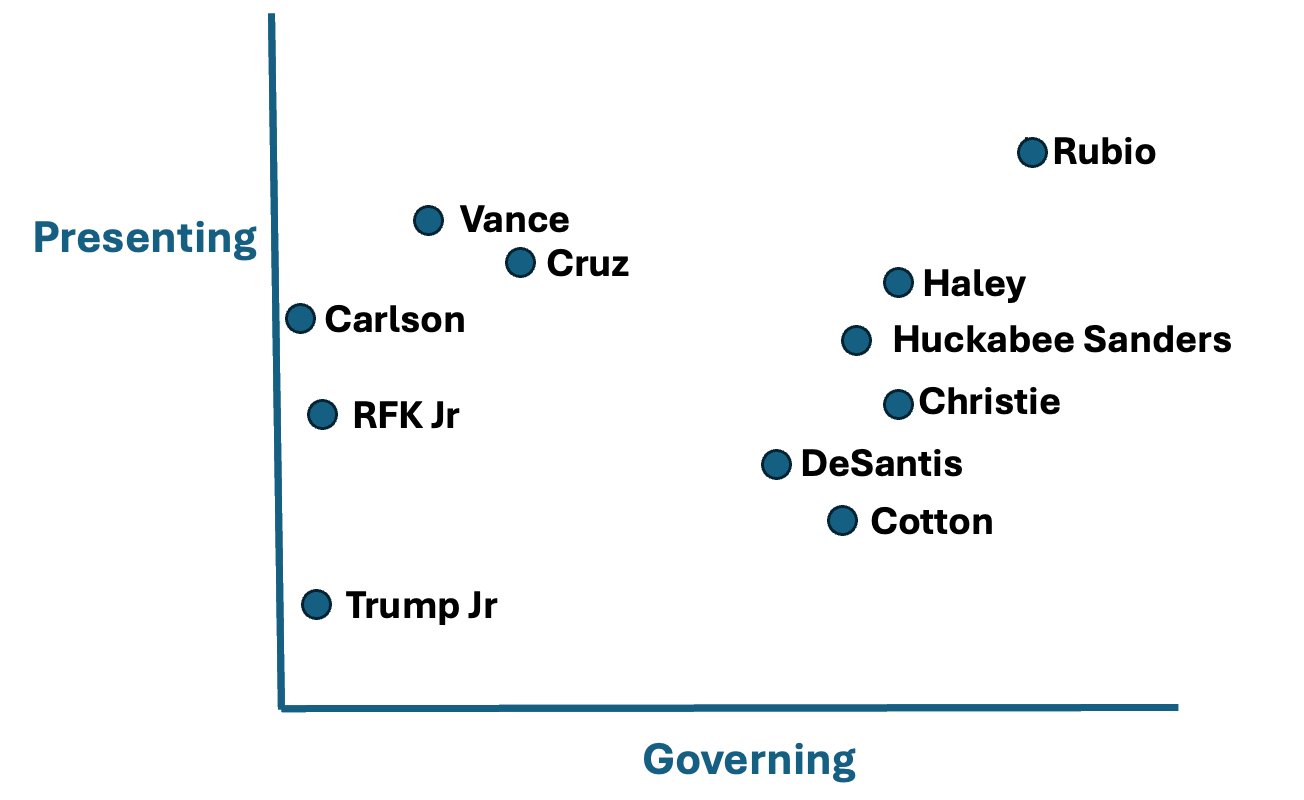
It seems to me that we need to decide if we want someone capable of and interested in governing well.
I sure hope so.
Civic or republican virtue requires the citizen serving in an official capacity to do the job and to prioritize the public good over the private good.
In other words, how effective was he at using the governing powers of his office to accomplish his goals? And how effective was he at projecting an image/message consonant with his vision of the national interest?