

When Courts Stop Discussions
The democratic costs of striking down laws

Out of Bounds
From as far back as I can remember until June 2022, to be pro-life was to be an outsider.
I don’t just mean “outsider” in the general sense of being in the minority. I mean that, in some circles, that position was considered out of bounds.
If this issue came up while I was in front of a left-of-center audience, my position was often met with a “How could you”-style response. I was once told the pro-life view was “bizarre.” More than once, I had people walk out of the room. More than once, I was told that to be pro-life was to be a misogynist. Once, I was walking with two colleagues at an education conference as they discussed how they could never send their kids to a Catholic school because it might make them pro-life.
I bring this up because last week I had the chance to talk to a group of very smart young people about abortion. They were part of a very left-of-center community. So I girded myself.
But it was not at all what I expected. It was a great conversation.
Afterward, I was told that the group had asked for a pro-life speaker. The Q&A was respectful, informed, curious, sincere.
The room didn’t have that “How could you believe that” feel. Instead, it had a “Why do you believe that” feel.
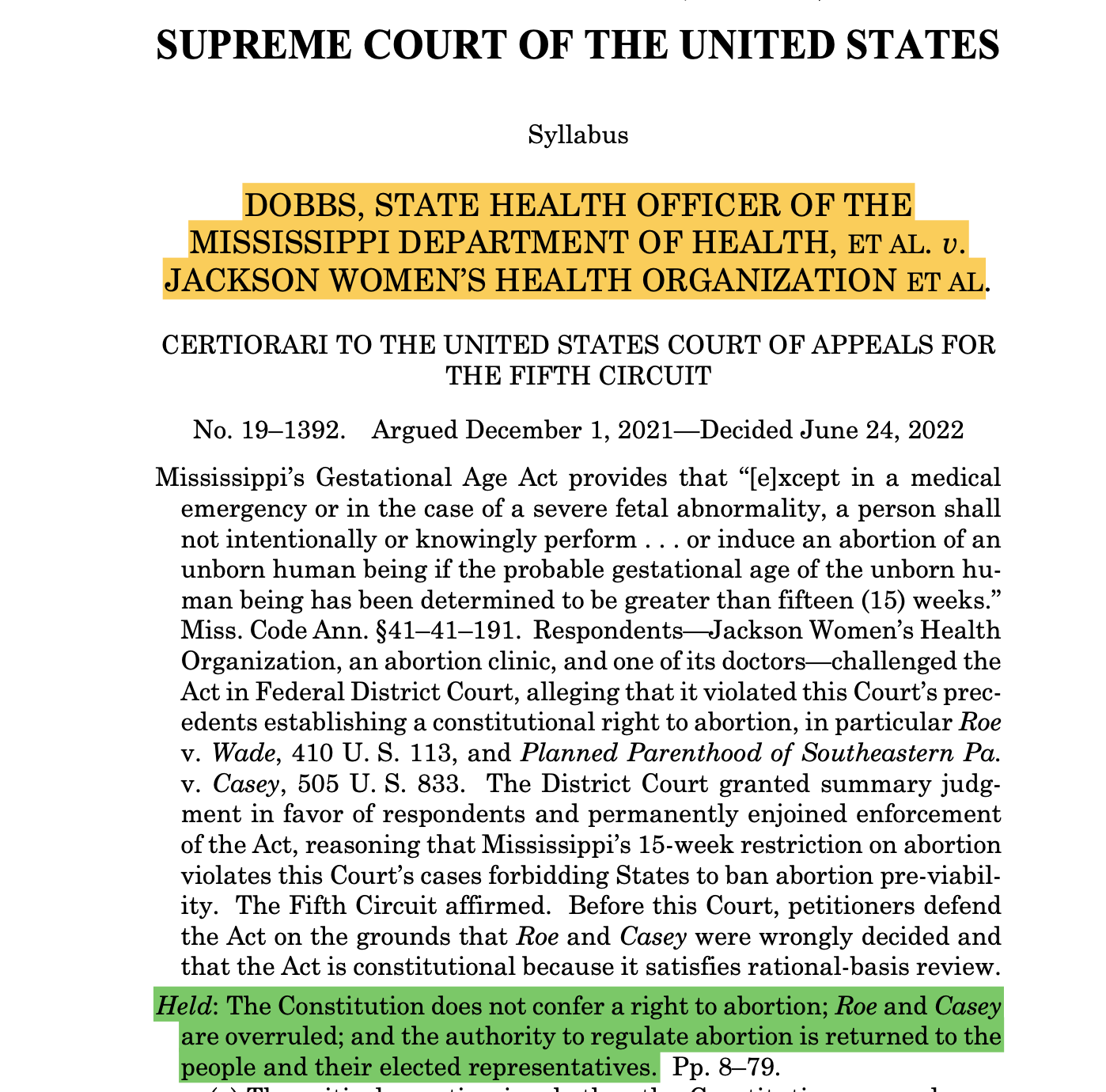
I think Dobbs—the SCOTUS decision that overruled Roe and Casey—had something to do with this.
The Deliberative Costs of Liberty
I generally dislike when the U.S. Supreme Court declares laws unconstitutional. Yes, of course, I want constitutional rights to be protected.1 But almost every time a court overturns a law, democracy loses: The people are stopped from governing themselves as they’d like.2 That breeds frustration and resentment. And it can feel like elite, Washington-based judges have substituted their judgment for that of the governed.
But there’s another problem.
When judges invalidate a law, they take an issue out of the realm of democratic decision-making. They tell the people, “We hereby prohibit you from doing X.” And this has two effects on democratic discourse.
The first is it places a stigma on those who want a law that does X. Judges have decided X is so out-of-bounds that democracy can’t justify it; X is contrary to our constitutional rights. So those who want X want something unacceptable.3
It’s not hard to see why the people who want X can be treated badly when they say they want X.4
The second effect is that it shuts down discussion of the issue. When judges remove something from democratic decision-making, they push it out of discourse and deliberation. Why would we debate something that can’t be done? Why would we entertain a view that is unconstitutional?
Those opposed to X (that is, the people on the only permissible side of the issue), have no reason to engage with or even take seriously those in favor of X (the impermissible side).
In these instances, we seldom have meaningful conversations about the matter. We no longer explore its moral or practical aspects.
Dobbs, Democracy, Deliberation
When Dobbs overturned Roe and Casey, it didn’t simply return the regulation of abortion to the states and to voters. It also returned abortion to the world of deliberation. This was once again an issue we could debate. An issue voters could engage with and do something about.
As the group’s smart, tough questions demonstrated, abortion all but demands deliberation. Why choose conception instead of viability or consciousness as the moment of “life”? If the mother’s and the baby’s lives are endangered, which is more valuable? If there’s not a right to abortion, should there be a right to life—meaning all abortions should be constitutionally prohibited? What does the pro-life community make of the increase in abortions since Dobbs?
In the middle of the 20th century, courts became more activist to protect the rights of Black Americans. That was the right thing to do. Racial discrimination should be deemed out-of-bounds (morally and because of the 14th Amendment). But courts were wrong to become activist in many other areas of political life. The judiciary removed too many issues from democratic decision-making and from public deliberation.
Democracy is a societal pressure valve. It enables us to deal forthrightly with tough issues and then find compromises. It gives us an outlet. It allows us to be heard and to have agency.
Courts sometimes act like they are doing America a favor by taking issues away from the people. In fact, sometimes courts can strengthen and decompress America by keeping an issue inside the democratic process.
The concern is not the protection of legitimate rights. In fact, in some cases, the protection of rights—like the right to vote—actually supports democracy. The problem is when courts invent rights or enlarge rights in ways that prevent the people from making laws that they should be allowed to make.
I’m expressing here a version of the “counter-majoritarian difficulty.” But we might look at the Constitution as the ultimate expression of the people; it is the nation’s democratically ratified charter. So when a statute is deemed unconstitutional, we might say that the democratically produced statute is inconsistent with the democratically produced Constitution. Since the Constitution is superior, it holds. And that means that democracy still wins. Said another way, the people created a charter that limits the people’s ability to make certain laws later on.
If the law in question is something related to, say, the separation of powers, the stigma attached to those on the losing side probably isn’t so bad. I don’t worry much, for instance, about those who feel personally hurt by a decision that declares their preference on the line-item veto to be unconstitutional. But if it’s a decision related to social-cultural issues, it is often a different story.
If someone advocates a law that blatantly violates a clear constitutional right, I don’t really mind if a stigma is attached. For example, if someone wants a law that imprisons Methodists and Lutherans (in violation of the clear language and intent of the Free Exercise Clause of the First Amendment), some amount of public disapproval is appropriate for those who continue to fight for the law after it is declared unconstitutional. The concern is when a stigma is attached to those in favor of a law that should be permitted.
100% agree that we see the "your viewpoint is out of bounds" attitude today because the courts took the issue out of public deliberation and made what was at the time the majority viewpoint (https://borncurious.blog/p/abortion-was-the-defund-the-police) not viable in the political sphere.
I take issue with court interventions being necessary to intervene on behalf of Black Americans in the middle of the 20th century. That's not obvious. I believe a bald majority supported desegregation nationally, and Section 5 of the 14th empowers Congress to enforce the amendment.
While I thank you for your comments reading this can lead a reasonable person to believe you are ignoring too many laws that are passed by a majority that are designed to negatively impact a minority in a way that a reasonable person would find just plain wrong. As an example, the State of Florida, with a population of 23 million is now attempting to pass a law to gerrymander their state in such an entirely hyper-partisan manner so that there may be only one of two congressional districts that have a Democrat in that US House seat. 28 seats in the state of Florida and 24 have Republicans. And now they want to do a new gerrymander to make it even more lopsided. The 2024 Congressional elections in Florida had a split of 55% Republican and 43% Democrats. How does that align with what the Republicans would like to have with 26 Repub and 2 Dem US House seats. Should a gerrymander law be struck down? Theories may be fine, political or otherwise, on paper but when that theory plays out in the real world, with real people looking to bends laws for partisan gain, the outcome often doesn't look or smell very good.